So
Happy
I've
Turned
40
5/14/08

4/30/08
The fountain keeper
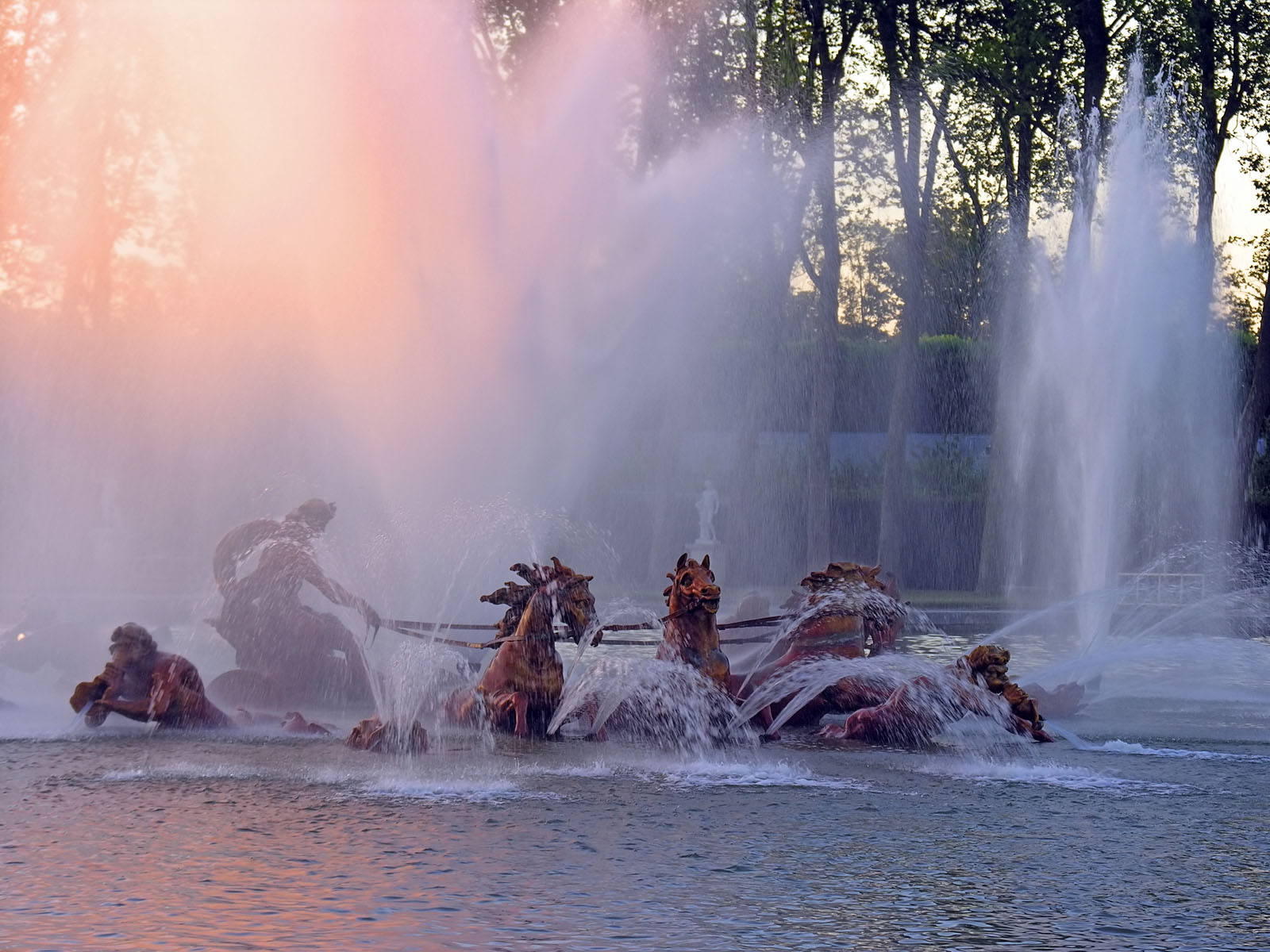
Of all the professions in all the world...it had never occured to me that there is such a thing as a fountain keeper. But there is, and I do believe every fountain keeper (can't possibly be that many??) envy Gilles Butez, the fountain keeper at Versailles - talk about prestige! He and his 12 colleagues make sure the waters dance the way they did to divert and entertain le Roi Soleil on his many strolls in the park. Today they dance alone, to the same music that once filled the castle with dancing dignitaries, and today, their purpose is to divert and entertain the herds of visitors hoping to get a glimpse of past magic. And according to M Butez, there is magic - in the water.
The lady is capricious
Avril avril macht wass er will, they say around here. And today, she (and I assume April is a female month, being of such an erratic and capricious nature) is using her last opportunity this year to do exactly as she pleases to the fullest. Like a bull raging against the fluttery red or a troll against the sun, and with the threat of May dangerously close, she is blowing seven winters upon us and turning light to dark so confused street lights turn themselves on in the middle of the day.
No wonder a poor gal gets awfully weather sick...
No wonder a poor gal gets awfully weather sick...
4/23/08
Merci d'être sympa

I like it when the buses of the city happily roll around with rears covered with the following message, illustrated with peace flowers: Merci d'être sympa. Thanks for being nice.
An attitude campaign, not a commercial campaign. I think the intent is to introduce this as traffic rule no 1, but it can safely (and somewhat sadly - in an ideal world we shouldn't need reminders to be nice...) be applied to the entire public space. I'm sure you can remember a time when a complete stranger smiled at you or even said something funny to you just passing by and how that just might have made your day.
I can not help but wonder though whether the bus drivers actually get the message...
So tomorrow, please go out and be nice to a stranger (even if it's the bus driver).
Flowers for thought

I don't quite understand why this exquisite little flower is called Stepmother's flower in Norwegian. We would rarely compare a stepmother to such a flower, right, what with Cinderella and all? Now I'm sure a lot of stepmums out there deserve to have a flower named after them, but still...
The French language however, lives up to its reputation and has a lovely name for it - pensée - a thought. That way, you can actually plant thoughts in your garden, you can even plant yellow thoughts, blue thoughts, violet thoughts, white thoughts... And not only that, you can plant big thoughts and small thoughts as well. Quite a philosophical garden!
In English, I belive one name for it is Heart's Ease, which is kind of nice as well. I guess that's exactly what you'll find in a garden of thoughts.
So, I hereby rename this flower to Thought's Flower.
4/18/08
Wherever I lay my hat...
... or - there's no place like home when away is home and home is away
Thoughts from a three-legged Norwegian with one leg in Luxembourg, one in France and one in Norway.
Where is home when you get a new home country? Can several places be home? And where is home - really? Choose the alternative(s) that suit(s) you best:
- Where naked little feet tread the grass - small spouts allowed to grow?
- Where you have lived for the longest time?
- In a room in a house in a garden?
- In the city or in the countryside or in the country?
- In an environment or a culture?
- Wherever you lay your hat - or your toothbrush for that matter?
- Where your heart is - or your nearest and dearest?
- Or quite simply where you feel at home?
There will be no evaluation or analysis of the answers, it is up to each reader to do that on his own. But I dare to guess - and hope - that many will select the last alternative, often in combination with one or several of the others.
An optional follow-up question for reflection: What makes you feel at home - or alternatively not at home?
My answer would be about feeling good within the four walls of the house, in the city and in the culture and about having good friends. To have my little family there with me would be an unquestionable condition. Back to the roots? Not those of my childhood tree, but perhaps to the roots that the mother country embraces her children with, as most mothers do. Or perhaps where new roots are put down.
Because what happens when you get new walls in a new city in a new country and in a new culture? That's when you really feel the embrace of the mother country. Her linguistic embrace, not mainly the spoken language, but all the codes fed to us through the breast milk and that we don't reflect upon until we find ourselves in a new place with a whole new set of codes, in a culture and a society that these codes are a natural part of. Then there are all the other codes. How do we act here? How do we behave towards one another? How do things work, like health care, social care, kindergartens and schools? Simply put, how do we live here?
Learning a new way of living requires time and energy, and a lot of it is about the little things that you didn't even think about back home because they were automatic. To feel at home in a new country takes even longer, and this is were the roots come in. Some roots must be put down in foreign soil, and the most important helpers is the social network. Friends. Making new friends takes time. So, the nice baker on the corner or the neighbour can become important helpers to start with. Then you must work up an understanding for - and perhaps even more importantly - a feeling for the country, for cultural, social and geographical surroundings. That's when a feeling of home might come sneaking up on you and you realize that it is possible to feel at home in more places than one.
The paradox is that getting roots in a new place might cause a certain rootlessness, as if the new roots tore up the old. Not quite at home in the new country as a foreigner, not quite at home in the old country, influenced by a different culture and by being able to see your home country from the outside - for better and worse. This might all be a bit confusing. And to add to the confusion, you could also try to make a home in a third country - because it feels like home....
A toothbrush in each country? Perhaps, but you should carefully choose where you put them. I have a toothbrush in a house in a funny little country with a funny little language and many other languages on every street corner called Luxembourg, who calls itself the green heart of Europe and who's kind of sneaking it's way into my heart. I have a toothbrush in a wry little appartment in an old town in France, and if I ever forget where my heart is, I'll be sure to find it there. And I have a toothbrush in a sailboat in Norway, our summer place back home. And when the sea is
lustrous, the night is bright and I can see with outside eyes, in a flicker of dog rose nostalgia, I can feel my roots and I can picture myself having toothbrushes there on a more permanent basis.
Thoughts from a three-legged Norwegian with one leg in Luxembourg, one in France and one in Norway.
Where is home when you get a new home country? Can several places be home? And where is home - really? Choose the alternative(s) that suit(s) you best:
- Where naked little feet tread the grass - small spouts allowed to grow?
- Where you have lived for the longest time?
- In a room in a house in a garden?
- In the city or in the countryside or in the country?
- In an environment or a culture?
- Wherever you lay your hat - or your toothbrush for that matter?
- Where your heart is - or your nearest and dearest?
- Or quite simply where you feel at home?
There will be no evaluation or analysis of the answers, it is up to each reader to do that on his own. But I dare to guess - and hope - that many will select the last alternative, often in combination with one or several of the others.
An optional follow-up question for reflection: What makes you feel at home - or alternatively not at home?
My answer would be about feeling good within the four walls of the house, in the city and in the culture and about having good friends. To have my little family there with me would be an unquestionable condition. Back to the roots? Not those of my childhood tree, but perhaps to the roots that the mother country embraces her children with, as most mothers do. Or perhaps where new roots are put down.
Because what happens when you get new walls in a new city in a new country and in a new culture? That's when you really feel the embrace of the mother country. Her linguistic embrace, not mainly the spoken language, but all the codes fed to us through the breast milk and that we don't reflect upon until we find ourselves in a new place with a whole new set of codes, in a culture and a society that these codes are a natural part of. Then there are all the other codes. How do we act here? How do we behave towards one another? How do things work, like health care, social care, kindergartens and schools? Simply put, how do we live here?
Learning a new way of living requires time and energy, and a lot of it is about the little things that you didn't even think about back home because they were automatic. To feel at home in a new country takes even longer, and this is were the roots come in. Some roots must be put down in foreign soil, and the most important helpers is the social network. Friends. Making new friends takes time. So, the nice baker on the corner or the neighbour can become important helpers to start with. Then you must work up an understanding for - and perhaps even more importantly - a feeling for the country, for cultural, social and geographical surroundings. That's when a feeling of home might come sneaking up on you and you realize that it is possible to feel at home in more places than one.
The paradox is that getting roots in a new place might cause a certain rootlessness, as if the new roots tore up the old. Not quite at home in the new country as a foreigner, not quite at home in the old country, influenced by a different culture and by being able to see your home country from the outside - for better and worse. This might all be a bit confusing. And to add to the confusion, you could also try to make a home in a third country - because it feels like home....
A toothbrush in each country? Perhaps, but you should carefully choose where you put them. I have a toothbrush in a house in a funny little country with a funny little language and many other languages on every street corner called Luxembourg, who calls itself the green heart of Europe and who's kind of sneaking it's way into my heart. I have a toothbrush in a wry little appartment in an old town in France, and if I ever forget where my heart is, I'll be sure to find it there. And I have a toothbrush in a sailboat in Norway, our summer place back home. And when the sea is
lustrous, the night is bright and I can see with outside eyes, in a flicker of dog rose nostalgia, I can feel my roots and I can picture myself having toothbrushes there on a more permanent basis.
4/17/08
Filming on a Saturday afternoon
Last Saturday afternoon, a man was arrested at a shopping mall, thanks to a security guard who observed a somewhat peculiar behaviour. It turned out that the man had a camera hidden in his shoe, and with it he filmed underneath the skirts and dresses of unknowing female shoppers. You could wonder how revealing the films could possibly be, he hardly had a spotlight in his shoe as well, and the weather here definitely calls for heavy underwear. Besides, it must have required some serious foot work. Searching his house, the polices found six pairs of similar shoes.
Oh well. One more reason to avoid shopping malls on a Saturday afternoon.
Oh well. One more reason to avoid shopping malls on a Saturday afternoon.
Subscribe to:
Posts (Atom)